INSIDETRIBALGAMING

5 of 5
Kewadin Casino locations forced to close by a single 2025 ransomware attack — which also shut down tribal health centers and dental services
$1.5M
In gaming revenue that federal regulators say tribal officials and consultants used to "line their own pockets" in just one Wisconsin case
527
Separate violations cited by the National Indian Gaming Commission in that single enforcement action — exposure of up to $27M in potential fines

"Line their own pockets."
The industry insists it is "regulated soundly" with "few demonstrated instances of corruption."
But when regulators actually looked, they found that a small circle of tribal leaders had been siphoning the community's gaming money into their own pockets — and fought the findings every step of the way.
The enumerated violations exposed a substantial breach of the trust placed in Tribal leadership … The misappropriation of this revenue … deprived vital tribal programs and government operations of at least $1.5 million.
— National Indian Gaming Commission, settlement statement — NIGC, 8/26/20
It becomes a potentially very public black eye at a time where actually the Indian gaming industry has been doing very well … there are few demonstrated instances of criminal activity or corruption.
— Steven Light, Institute for the Study of Tribal Gaming Law & Policy — Wisconsin Public Radio, 5/13/19
One council member used gaming revenues to pay for eight trips to New Mexico, Las Vegas and Hawaii.
— Wisconsin Public Radio, detailing the NIGC's 527-violation citation — 5/13/19
Tribal council members, gaming commissioners and consultants used at least $1.5 million in gaming revenues to 'line their own pockets.'
— National Indian Gaming Commission, on the St. Croix Chippewa Indians of Wisconsin — Wisconsin Public Radio, 5/13/19
A "$44 billion" industry — concentrated in a few hands.
The lobby speaks for "tribal communities."
But its own regulator's numbers show how narrowly the winnings are shared.


A pattern, not an accident.
Each of these comes from tribal, industry or regulatory sources — not opponents.
Read together, they undercut the "sound governance" story the lobby tells in Washington.
2025
Attacks knock out casinos and tribal health care.
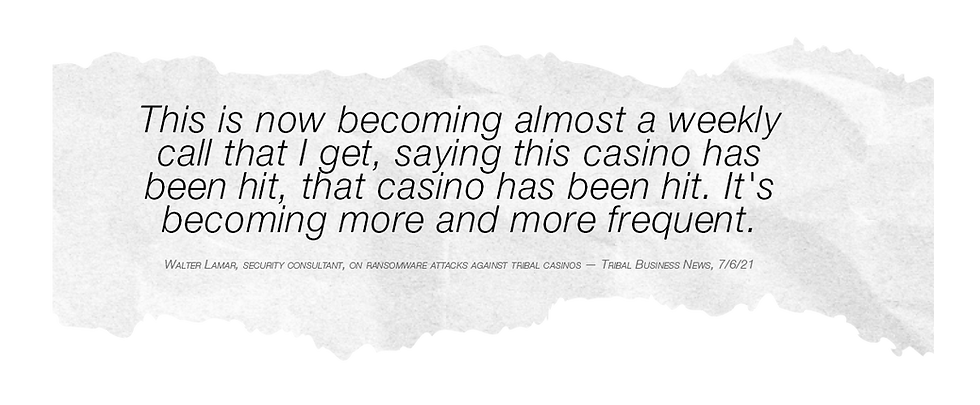
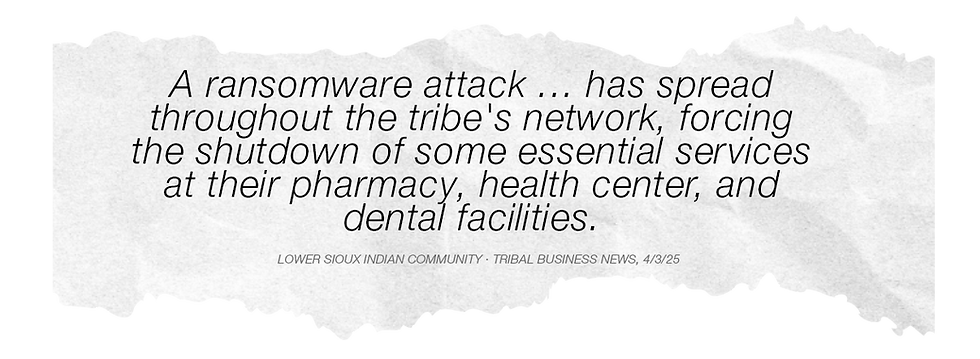
A single attack closed all five Kewadin casinos and forced cancellation of medical, radiology and dental appointments for Michigan's largest tribe. Weeks later, a separate attack shut down pharmacy, health-center and dental services for the Lower Sioux community. (Tribal Business News, 2/13/25 & 4/3/25)
2020
Two tribes pay ransoms to reopen their casinos.
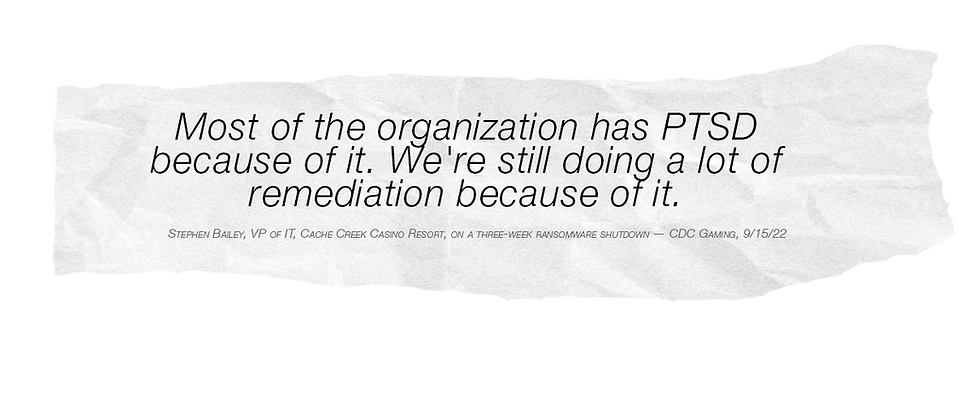
The Yavapai-Prescott tribe's casinos stayed dark for two weeks and "did not reopen until they made a ransomware payment." Cache Creek closed for three weeks after an "external attack on our computer network." (CDC Gaming, 9/15/22 · The Sacramento Bee, 9/30/20)
2019
$5.5M fine, 527 violations, up to $27M in potential penalties.
The NIGC cited the St. Croix Chippewa for using gaming revenue as a personal fund — including a half-million dollars in direct payments to seven tribal members between 2015 and 2017. Officials "refused to accept responsibility," regulators said. (Wisconsin Public Radio, 5/13/19)
2017
Regulators shut a casino over drinking-water and safety failures.
The NIGC ordered the Nooksack Tribe to close its Northwood Casino after finding it "failed to maintain and operate the gaming facility in a manner that adequately protects the environment and public health and safety," citing "significant deficiencies of the Safe Drinking Water Act … at six water systems." (Indian Country Today, 6/16/17)
Public Safety & Cybersecurity
When the casino goes dark, so does the clinic.
Because so many tribal governments run their health care, pharmacies and public services off the same networks as their casinos, a cyberattack on the slot floor becomes a crisis for the whole community. These are not hypotheticals — they are the industry's own recent headlines.


Before you take their word for it, look at the record.